Monday, September 23, 2013

I food you, I got pig iron

"I dined on cuisse du poulet roti -- roast chicken -- while my companion ventured the steak tartare --a caper-dotted paddy procured from an artisan butcher just a mile down the road. As we finished our last bites, the waitress brought assorted cheese to our table ("Fromage!" she sang), and then the meal was topped off with a sweet crumble aux pomme"  (source: The good food of France's truck stops)

My job takes me through the 11 western States and not once have I found a "caper-dotted paddy" (sic) along my travels.

Finding good food is a lot easier said than done.

Bob's Cafe - Moses Lake, WA
Due to the nature of the business, I am mainly routed on Interstate highways, not on picturesque country roads through quaint towns with bistros. Even if I were able to drive wherever I wanted to, I still wouldn't be able to park nearby a bistro. There's simply no room.

I am constantly followed by a 53-foot-long trailer and finding a parking space for it is always a challenge. In practical terms, I can eat only whatever is within a reasonable walking distance from the truck. Truck stop parking lots are often so far from actual civilization that I usually settle upon whatever crappy vittles are on offer.

What's usually on offer at truck stops along the Interstate is fast food; Subway, Arby's, Taco Bell, Wendy's, Burger King, sometimes a Denny's. And I have learned just what to eat at each of these places. Taco Bell has the Cantina Bowl, a passable dish that contains Romaine lettuce and is somewhat edible. Denny's has an "all you can eat" deal of soup & Caesar salad for $6.00, and Subway can make an item that, at first glance, appears to be a sandwich.

Arby's has nothing but crap. Avoid Arby's.

Arctic Circle, Payette, ID

As I gain experience, I am learning where and where not to stop. I always choose independently-owned cafes whenever possible, but these usually are not much better since most still worship at the Sysco food service alter. When I see a taco truck, I always stop. (There are three along I-84 in Boardman, OR).

Why don't I prepare my own food? 

That's a lot easier said than done. I am cooking for one. Cooking for one is always a pain. And if I wanted to prepare fresh food, where would I even get it? I see all sorts of places that sell groceries, but I usually cannot stop there; I can't very well park my 53' trailer in a Safeway parking lot. And if I bought some perishable food, where would I store it? I don't own a fridge, and ice chests are too much bother. Even if I cooked a caper-studded steak and pom frites, then where would I wash my dishes? You can see just how quickly involved this gets. Other drivers prattle on endlessly about their crockpots, microwave ovens and George Foreman grills. That's not for me. I have many miles to drive, and a getting that committed doesn't enter into my plans right now.

To save some money, I bought an electric kettle that I power off of an inverter. What I have been doing is making coffee (drip, #2 filter, Italian roast) with half & half (Mini Moos) in the morning. I also picked up a cheap toaster and have been making toasted peanut butter & honey sandwiches on whole grain bread. I usually keep some bananas around and always keep a stock of apples to munch on. And I am one with instant oatmeal.

Anything kept in my larder must be non-perishable. Lunch and dinner snacks regularly include the fantastic Bumble Bee Thai Tuna & Crackers, Nissin instant chow mein plus whatever else I can scrounge up that won't go bad and won't go straight to my hips. (That means no Ho-Ho's, Ding Dongs, Bugles or Funyuns)

I am certain that, if I really tried, I could pare all this down to sun-baked kale chips and celery broth, but I won't. Those that pester me with solar soy taco pointers get immediately unfriended. I will write the truck driver's healthy cookbook some other day. Right now, it's all I can do to keep the truck driving in a straight line.


Tuesday, September 03, 2013

The scales of justice

I had been dispatched up to Portland so that I could swap my empty trailer for a fully loaded trailer.

Somewhere along the way, I had gotten lost. It was rush hour, and I had taken a wrong turn and ended up circling on residential streets where large trucks do not belong. I was flustered. I had not followed the simple directions and now my GPS was only making matters worse. My nerves were shot, but I finally got to where I was supposed to go, which was just off of exit 307.

I found my new, loaded trailer easily enough (it was parked in amidst a bunch of other trailers), but there were no empty slots where I could stick my old trailer. This was not going to be fun. To make it work, I had to drop my empty trailer somewhere out of the way, hook up to the loaded one, pull it out and place it alongside my empty trailer, drop it in the dirt and then stuff my old, empty trailer in the hole that I had just created. I dropped that trailer and went and got my new, loaded trailer and hooked it up. After all that, I was a sweaty mess.

I had done everything right, save for one crucial thing: In my haste, I had forgotten to scale my load. I had no idea how heavy it was. And as it turned out, I was 2,200 pounds overweight on my tandem axle. I found out this fact when I had to sign a citation presented by the nice man with a gold badge from the great State of Oregon. And it was my own damn fault, because I had been careless. I had been taught (repeatedly) to always scale a load.

That was an expensive lesson.


Several times a day, I have to stop at highway scales. These are operated by the Department of Transportation in whatever State I happen to be in. In general, they are looking for overweight trucks, but they are also on the lookout for all sorts of things.

Inside my cab, stuck to the inside of the windshield, are a couple of "prepass" units. They are little, plastic boxes and closely resemble the ones that are commonly used to pay bridge tolls. These prepass units identify me about a mile in advance to the DOT guys, and depending upon their mood, I will get an "in cab" signal of a green LED light or a red LED light (along with an audible beep signal to help alert me). Presumably, before I even approach the weigh station, the DOT guys know precisely what trucking company I am with and instantly can see our laudable safety record.

About a third of the time, the prepass unit displays the green LED light and I can drive right on by the scales without stopping. About a third of the time, I get a red light and have to pull in, gear way down and slow to three mph in order to get my truck weighed. The rest of the time, the scales are simply closed. There is no telling which scales will be open when, which makes it sort of interesting. However, the scales at each State's port of entry are invariably open and happy to weigh everyone, sort of like a Jenny Craig's for Truckers.

Scaling a load correctly is routine, but it is not intuitive. It is not simply the overall weight of the truck and its contents; what also matters is how that load is distributed. With the sort of tractor-trailer combination vehicle that I pilot, one cannot have more than 34,000 pounds on either the drive axles or on the tandem axles. With this particular offending load (which were bales of scrap paper, as it turned out), my weight was fine but my load distribution was funky. Before I was allowed to drive onwards, I had to slide my tandem wheels backwards by six notches. When I did that, the load was deemed legal again and I was free to go on my merry way. My truck still weighed the same, but my wallet was now $200 lighter.

As I said, it was all my fault. My company is more than happy to pay for scaling. I frequently visit truck stops just so that I can cross a scale and get weighed properly before I head out onto the highway. It only costs my company $10.00. At a certified "public scale", I get a nifty printout showing the weight of my steer, drive and tandem wheels. Once I have that in hand, I become downright smug.

The next day, I had an entirely different load (a load of unscented, 2-ply toilet tissue, as it turned out). Even though the trailer was filled, it was not all that heavy, as compared to a dense load of spring water, for example. (when loads are comparatively heavy, say around 40,000 pounds, you immediately feel the difference in the way the truck drives). I knew the weight of this load, and I was feeling pretty good about it.

Going southbound into California on I-5, the first scales that you come to are around Dunsmuir. They're always open. I had to pull in to the scales, but I was certain that my load was perfectly legal. As one drives across the scales, the driver sees a set of standard traffic lights to guide you, and they usually stay green. But when I pulled across the scales in Dunsmuir, the traffic lights changed from green to red. A stern voice came over the PA system. "Driver, pull into bay number four". What had I done? I nearly wet my pants.

"Bay #4" was a garage, a huge garage, big enough to contain the entire tractor and trailer. The doors closed behind me. A Highway Patrol officer was inside, waiting for me. "How are you doing today, Driver?" he asked. I replied, in all honesty, that I was scared shitless. He smiled, and then he put on disposable gloves.
In my experience, that is never good a good sign.

I had been "selected" for a Level One inspection. It was not at all random, but it didn't have anything to do with the overweight citation, my current load of unscented, 2-ply toilet paper or even my liberal voting history. A yellow sticker on the lower right side of my windshield was expired and that had tipped off the inspectors.

The inside of the garage was mostly dark, save for the bright white, four-foot-long florescent lamps that were flush-mounted into the concrete floor, sort of like a disco dance floor for big rigs. I was first asked to provide identification for myself. I produced my spiffy Commercial Drivers License and my current DOT medical "green" card, both of which are, thankfully, genuine. Next, I needed to come up with registration for the truck and trailer, then provide the Bill of Lading for my load of toilet paper. I had all of that.

He asked to see my logs. I grabbed the Qualcomm unit off of the floor, switched to my log's summary page and held it out the window for him to see, pulling it as far as its black, coiled power cord would allow me to. I had plenty of hours left and was fully in compliance.

Next up, he wanted to see that all the truck's lights and turn signals were functional. They were. He asked me to pop the hood; under there he inspected belts, clamps and hoses, presumably looking for drips and leaks.
As the tractor had just been serviced and is in pretty good overall shape, I wasn't worried.

The wild card was the trailer. Remember, we drive the same tractor every day but pull different ratty-ass trailers most days. I know my tractor intimately, but each trailer is a complete stranger to me.

Obviously, I do a pre-trip inspection on the trailer each time I get a new one, but I am only checking out the lights, air supply glad hands and the tire pressure. I don't actually climb underneath to inspect brake chambers or look for tiny droplets of oil on brake shoes. Yet that was what the CHP inspector was up to. And he had a lit-up floor and a mechanic's creeper with which to do it. Any mechanical defects would soon become apparent.

I was asked to engage the brakes and to keep them engaged. He slid under the trailer. I kept my right foot on the brake pedal. I have no idea how long this lasted, but it seemed to go on forever. My right leg was not happy. I prayed that there was sufficient brake lining on the brake shoes and that the brake chambers would hold pressure. Eventually, the man and the creeper slid out from underneath the trailer.

He told me that he "had some good news and some bad news". I winced.

The good news is that my truck and trailer had passed a thorough inspection.We would be awarded a new windshield sticker, this time orange in color.

The bad news? He looked me straight in the eye and told me, "is that you have to go back to work".


Sunday, August 18, 2013

The load from hell is paved with bad information


When the company that I work for wants us to go somewhere and do something, they send us an email-like dispatch via the Qualcomm unit. The dispatch is a standardized set of instructions telling us the name and address of shipper, the consignee, what date and time it is scheduled to be picked up and delivered, the weight of the load, etc. It is chock full of information.

When the dispatch from hell came in, I couldn’t fully decipher it. The pick-up date had long passed; the delivery date was missed too. There seemed to be several different places where it needed to go. This load was waiting in a preloaded trailer that had been parked in our yard in Yolo, CA.

Every trailer has a gray, plastic container affixed to its outside. It serves as sort of a “mailbox” from one driver to the next. The previous driver for this load had left the paperwork for the next driver, which turned out to be me. But when I checked numbers on the paperwork, they didn’t match what the original dispatch had stated. Even the paperwork itself seemed dodgy. I walked to the back of the trailer and checked the number on the seal. That number didn’t match either. Something smelled fishy. This was a load with problems.
Using the Qualcomm machine-thingy, I sent a note back to my amazing Driver Manager stating my findings and asking for more details. She responded that this load was “OS&D” (the acronym for “Overages, Shortages and Damaged”) and, (here I paraphrase, but not by much) “just shut up and do what you’re told”.

The load wasn’t even going very far; just to West Sacramento. I was only at our Yolo yard, which is basically Woodland. Maybe 30 miles, if that? How hard could this be? Still, something just didn’t seem right.

I found the address easily enough. I pulled up to the distribution center right behind a queue of trucks all waiting to get inside the gates for nighttime unloading. My appointment was for 7:30 pm. I arrived a little bit early, just maybe 20 minutes or so. Being early is good; sometimes you get out of there a little bit quicker.

I parked my truck and walked over to the kiosk to check in. I was told by the nice lady at the kiosk that, since my load was one that had been rescheduled, I would need to pay a fee of $500.00. When that $500 fee was paid, they would assign a loading dock door to me, but not until then. Clearly, getting a load rescheduled at this place was very costly.

Nobody had told me about this. Nobody ever tells me anything.

Back at the truck, I sent a message back to the Mothership in order to tell them the situation and asking for $500. It took seemingly forever before they sent the money, and instead of paying the fee directly, they sent funds to me via my Comdata card.

Comdata is kind of like a trucker’s version of Western Union.

Everyone is issued a blue, plastic card that looks just like a credit card. We use the Comdata card like an ATM card, as a gift card, as a gas station credit card, but most often we use it for money transfer; like a trucker’s version of Western Union. Most of the time, the Comdata card has a zero balance. (Even my pay arrives each week via a transfer to my Comdata card. Once it’s there, I transfer it to my own bank Cumbersome doesn’t even begin to describe it)

The person at the kiosk had given me a sheet of instructions with my fee amount and a phone number somewhere in Colorado to call. Apparently, this was the administrative office for “Lumpers Central”.

Lumpers are people who are paid to unload trucks at distribution centers, but who are not technically employed by the distribution center. They exist in an alternate universe. I call them Lumperistas. The truck driver, not the distribution center, pays them for their unloading work unless the driver feels like unloading the entire truck himself, (which he wouldn’t, unless he happens to have a forklift in his back pocket.).

The Lumpers Central lady had a Comdata draft, which is sort of like a universal blank check. She told me the control number for this check and I wrote the number down. The money needed to be transferred to this specific check, just like a ransom money drop. The hostage (my load of paper napkins) wouldn’t be freed until I paid the ransom (fee).

After an hour and a half, the Qualcomm machine squawked with the news that funds had finally been transferred into my Comdata account. I called up Comdata on their toll-free number, entered my card number, my PIN and then transferred the $500.00 to the Comdata draft number that the nice lady had given me. Once that was done, I called back the nice lady and told her that I had just paid the ransom fee. She sent a message electronically back to the lady in the kiosk back at the distribution center, and that lady assigned me door 36.

At this point, it was long past dark. Normally, distribution centers have extreme lighting; nighttime is just as well illuminated as day. But not this one. It was pitch black. Also, the helpful, painted lines had long since been worn off by countless truck tires, so backing into door 36 was a pain in the butt. (Trailers don’t have backup lights. Tractors have a “utility light” behind the cab, but any chance of that light’s usefulness is blocked by the trailer. I needed to see behind the trailer. To see anything at all in the dark behind you, you have to apply the brakes ever-so-gently so that the brake lights serve as de facto backup lights, otherwise you can’t see diddly)

I eventually got my trailer aligned, but it took me about 10 lame-ass tries. Once I bumped the dock, the Lumperistas started unloading almost immediately. Unloading the truck was easy, but they also had to sort and count the load and that takes much, much longer.

Sometime close to midnight, the on-site accountant for the Lumperistas informed me that the Lumper fee for unloading the load from hell had come to $161.00. Once that fee was paid, I could have my signed paperwork, leave and go home to bed. Using the Qualcomm machine thingy, I sent a message requesting payment for my new Lumper pals. I sent the message in at 12:07 am and waited for a response. Finally, at 1:30 am, the Qualcomm machine squawked with news of Lumper money, waking me up from an impromptu, driver’s seat nap. I went through the stupid money-transferring procedures again, retrieved my signed bill of lading and finally drove the flock out of there.

I made it back to the Yolo yard by 2:30 am and crawled into bed. I was very, very glad to be rid of this ridiculously easy, simple, short-distance load; the load from hell.


Sunday, July 28, 2013

Time is of the essence


I didn’t even understand what had gone wrong.

I was rapidly running out of available driving hours. There was no way that I would be able to make it to the consignee with the amount of “run-able" (legal) hours that I had left. I pulled over alongside the Interstate and sent a frantic Qualcomm message to my Driver Manager telling her that I would not be able to deliver on time. She called me up on my cell phone and was pretty angry, short and snippy. I was told that another driver would be taking my load to Portland. After she hung up on me, I felt very humiliated. 

I had just completed a very productive and busy week. My last delivery for the week was to a Lowe’s store in Boise, ID. When they were finally finished unloading my trailer, I only had about an hour or so left on my clock. I took my stinky self and my truck to the nearest truck stop; only about ten minutes away and shut down. I was within an hour of officially running out of time.

The D.O.T. clock rules everything that I do. The moment that I begin the work day, I change the Qualcomm from “Sleeper” mode to the “On Duty” setting. That begins my 14 hour clock. Once started, that 14 hour clock cannot be stopped until it runs out. Contained within that 14 hour time period are my 11 hours of driving time. I can start and stop the 11 hour driving clock as much as I like, in order to, say, eat a chimichanga or to go visit the potty. It just all has to be done within a defined 14 hour time period. (When those 14 hours are up, you have to shut down for 10 hours; whether or not you've been driving.) Fun fact: the electronic 11 hour driving clock cannot be cheated; once the truck starts rolling, it senses that you're moving and automatically switches to “Driving”.

There are only so many 14-hour clocks available. You are only allowed to work 70 hours before the D.O.T. clock has used up all of its available hours for the week. To continue, you are required to take a “reset”. A “reset” is a 34 hour period of time when the truck and the driver cannot work. There is well-founded concern that truck drivers are working excessive hours and, because of that are sleep-deprived and a real menace to themselves and others. It is my belief that, without enforcement of the “hours of service” regulations, that the Trucking Industry would run its drivers to death, literally.

I had parked my truck at the T/A Truckstop in Boise just after 9:00 am and was prepared to sit for 34 hours. It was not to be that simple, however. There are some brand new rules, rules that just came into effect on July 1st. Now, the 34 hour reset must include two consecutive periods of time between 1:00 and 5:00 am. My reset would instead be completed at 5:00 am, two days later. I would be stuck sitting in a crummy truck stop for almost two whole days.

But I got through that, and on the correct evening just before bed, I had set my iPhone’s alarm to wake me up at 4:30 am. When it woke me up, I took my sweet time to visit the restroom, get a cup of coffee and read my email. At about 5:30, I changed my status to “On Duty”, did my pre-trip and headed out on the road. Everything was right with the world, except for my DOT clock.

This is where I screwed up.

The D.O.T. clock on the Qualcomm unit was set to Pacific time, but my iPhone had switched over to Mountain time. It was not 5:00 am yet. Whoops! I had started my DOT clock about a half hour too early and had destroyed my 34 hour reset and I had run out of time by simply being stupid and forgetting about the time zone change. And no, you don’t get your full 70 hours back until you do another 34 hour reset. You do get “refunded” a few hours each day (due to a complicated exception that is far too dull to explain), so I parked for another day, kicked myself repeatedly and promised to never, ever ever make such a stupid newbie mistake again.

A few days later, I was driving west with a truckload of beer. I pulled over to grab a chimichanga in Boardman, OR. While I was eating my lunch, I received a Qualcomm message from my Driver Manager. “Stay put!” the message said, “You are going to swap loads with another driver”. A very sheepish-looking driver eventually caught up with me and we swapped trailers. He was out of time, having made the exact same mistake as I had. I had plenty of available driving time, he did not.

If we learn from our mistakes, I am getting a fantastic education.


Wednesday, July 10, 2013

The best, late plans.


Driving the truck is the easiest part of the job. All you have to do is steer it kinda straight, keep your left door shut and try not to hit anything. Any idiot can do it, and plenty do. (They mostly drive for Swift)

Sure: there are the astonishingly long hours; endless unhealthy foods to eat and very few opportunities to pee in a clean, well-lighted place, but comparatively, driving the truck is the easy part when compared with everything else.

The hardest part of this job is planning the trip and then executing the plan intelligently so that the load isn’t late. Right at the entrance to our company headquarters, there is a big, red sign that warns the drivers: “No late loads” which I take to really mean: “Be on time, you knuckleheads!”.

That “on time” part is the hardest part for me. I am focusing on the “on time” part a lot these days, and I’m doing so not because I am especially good at it. If I were any good at it, I would be writing about something else, like maybe where to find the best roadside chimichanga.

There are people in my company with the job title of “Planner” who, with the help of fancy software, determine exactly which driver will be available when, which of them will be close enough to a shipper to be helpful and which drivers have enough available DOT time to get a load from point “A” to point “B” within a specific time constraint.

Generally, the Planners know a lot more about the feasibility than some portly, newbie driver (no specific person in mind). There isn’t a lot of “down time” and there is very little room for error. The Planners are tasked with keeping the trucks moving. (A truck is not making money for the company unless it is constantly moving. Think: Southwest Airlines; same idea).

Once they have someone in mind, they send out a message on the Qualcomm unit “asking” the driver if they want the load. It is not really a question; it’s more of a polite formality. A driver cannot turn down a load unless they have a really good reason. The only possible good reason to turn down a load would be “I really don’t want to work here anymore”.

Every day or so, the Planners send a load my way via the Qualcomm unit. Despite misgivings, I “accept” the load, and then I start the “trip planning” portion of the show. Simply put, the Shipper wants their load picked up at a certain time and the Consignee wants it to be delivered at a certain time as well. Got it! Life is good so far.

There is a simple method to figure out how long it takes to get someplace. Just know the distance and that one averages 50 mph and you're good to go. And since I like to drive at about 57 mph, this should be fine; it should account for any pee stops and the occasional visits to taco trucks that are selling chimichangas along the way. Except that it doesn’t.

The shipper is not just waiting around, hoping that you will brighten up their day with your presence; they have other trucks forming a line right in front of you on the entrance road leading up to a guard shack. And the guards (who, by the way, are unfailingly polite, courteous and efficient) have to get your paperwork in order, check your ID against their records, double-check your seals (if loaded) or inspect your trailer (if empty) and all of that takes time. Plus, they often have to explain to the portly, newbie driver just where to drop his empty trailer and where he might also find his pre-loaded trailer.

The clueless newbie (me) then drives forward into their yard (10 mph; four-way flashers on), finds the correct spot to drop the empty, but he first needs to slide the tandems on the trailer backwards (this is necessary so that loaded, heavy forklifts can safely drive inside the trailer).

In order to slide the tandems, first I have to unlock their locking pins. About half the time, the two-inch-thick tandem locking pins are rusty (and are effectively frozen in place) and pulling the handle gets you nowhere, so I have to use a pair of Vice Grips in an attempt to hold the release handle in place while I run back to the tractor, climb back up inside, release the brakes and “rock’ the trailer back and forth with the tractor until the pins agree to play along and finally release. Certain words (words that were only recently learned at truck school) are muttered during this process.
Waiting at the dock for a green light

Eventually, I find and get hooked up to a different, (this time: fully-loaded) trailer, drive back to the entrance where the friendly security guards double-check the seal numbers on the trailer doors before bidding me adieu. Then, I get to drive out of the terminal and then back out onto the Interstate.

The Interstate that is currently under construction. I’m not talking about any Interstate in particular; ALL Interstates are perpetually under construction. I think that they must see me coming and hurriedly set out orange cones. By law, I must slow down. I lose time.

I set the cruise control, turn up the tunes, drive merrily along at 57 mph and flick boogers down onto the passing cars. That works great until there is a hill in front of me. Little hills I can deal with; the mighty Cummins engine pulls them with no worries, but big hills (with names like “The Grapevine” or “The Siskiyous”) require me to gear down and gear down and gear down until I find myself chugging along up a 6% grade at 25 mph with my four-way flashers going blinkity-blink. I lose more time. Snot-encrusted cars pass me in the left lane and yell something as they speed by. 


Sometime between three hours after my day begins yet before eight hours have transpired, I must take a 30 minute break. Normally, this is never a problem because even I need to eat, drink and tinkle now and then, but as of July 1st, 2013, the midday, 30 minute break is now a federally mandated requirement.

Generally, my delivery destinations are about a day and one half away and most of the time, my delivery appointment is scheduled for the early morning. I can only legally drive for 11 hours a day out of the 14 hour workday, no matter how fast I am going or what steep hills are in between the Shipper and the Consignee. After my 11 hours of driving time, I need to stop somewhere. To be in compliance with DOT regulations, I need to be shut down for an uninterrupted 10 hours, but I also kinda need to be close enough to my destination in order to get there the next day on time, allowing, perhaps, for mountain passes, road construction, city commute traffic and traffic accidents that block entire freeways.

In addition, my awesome Driver Manager would prefer that I get to the destination somewhat early (so that we don’t lose the account), perhaps a couple of hours early?So I need to drive as many miles as I can (so as to be within spitting distance of the Consignee) while still allotting 10 hours of sleep time. This is becoming a math-word problem. Math is hard.

But where shall I lay my head down to sleep? If I make miles and drive late into the night, all the best truck stops (ie: closest to the Consignee) will be long filled up, yet it doesn’t make sense to stop early in the day when there might still be available parking spots (truck stops are usually quite full for the night by 4:00 pm) and I won’t be close enough to my destination anyway. And if I drive late into the night, there might not be enough available time left over after taking my 10 hour break to get to my appointment on time.

Let’s review: I still have to get to my destination on time. I cannot speed in the truck. My truck is governed to 62 mph. I have to stop somewhere for 10 hours. I have to do a 15 minute pre-trip inspection every morning. I have to contend with rush hour traffic, traffic accidents, steep hills and endless road construction. I may need to stop now and then to eat something that’s clearly unhealthy. And when I get to my appointment, I still have to fuss around with balky tandems before breaking the seal, opening the trailer doors and backing up in a straight line until I bump up against their loading dock. My head is starting to hurt and I really need to empty my bladder. My perfect trip planning has gone pear-shaped.

The consignee isn’t just waiting only for my delivery; they are expecting other trucks that day too. They have only so many available loading docks, forklifts and receiving staff and they may not be able to accommodate my late ass. If I miss my scheduled appointment, my entire load might actually be refused (which has already happened to me twice).

When that happens, it’s not just embarrassing for me; it also impacts and annoys countless people. My awesome Driver Manager (who is monitoring, in real time, by satellite, every single misstep that I make each and every day) has to notify our Customer Service department who has to call up and ask the customer to please ask their receiving department to re-schedule the delivery (“that our knucklehead driver missed”) for another day. When that happens, I get very sad.

And all of this occurred because I was taking way too long to eat a chimichanga at the taco truck in Buttonwillow.

Sunday, June 23, 2013

The truck stops here

Truck stops are ghettos for people that have 53 foot trailers.

Trucks, being big, heavy and really hard to turn around are not allowed on most city streets and they are certainly not allowed to park wherever they want to. If it were not for truck stops, there would be humongous trucks parked all over the place; parked all here and there and everywhere. (It would be a real nuisance. You would never be able to back out of your own driveway.) Big trucks are allowed on main highways and onto just enough streets to get them to their terminals and whatnot, but pretty much nowhere else. That leaves truck stops as about the only places where they are allowed to go when they're not out on the open road.

I go to truck stops, but I really really really don't like truck stops. I try to avoid them whenever possible.
New haircut, same attitude.

Truck stops usually are from one of these brands: Pilot, Love's and TA. There are some independent truck stops too, but the company decrees exactly when and where we are allowed to buy fuel, and since it is always one of the soulless brand-name majors, I usually have to stop at one of those soulless brand-name majors.

Truck stops have lotsa parking spots that are big enough to hold really big trucks. There are usually over one hundred or more of these parking places, but there are never quite enough to meet demand so the parking lots are about full up by early afternoon. Any spots that are left over are only available because they're very hard to back into (especially for a newbie like myself) or directly adjacent to a stinky, poop-encrusted cattle truck. And instead of getting an easy "pull-through" parking spot, you have to do a 90 degree backing maneuver into a spot directly between two expensive trucks while judgmental truckers with names like "Bubba" are watching. My advice: don't hit somebody's expensive truck when you're parking.

The drivers with actual experience make sure that they get there early in order to get a good spot. I contend that they plan their entire work day around that night's parking spot. However, when one's drive finishes up late at night (and that "one" is me), one is going to find himself shit out of luck finding a suitable spot to park and one will find himself parked somewhere by the side of a busy road, at a noisy, freeway off-ramp or somewhere else that's pretty awful.

Truck stops sell just about everything a trucker might need. Besides a spot to park for the night, they sell fuel, really big tires, truck service, truck washes and public scales. The scales are for weighing the truck, not the driver (although I have seen some pretty large truckers who would need to use them).

Inside the truck stop is where all the "cool" stuff is. They always feature some sort of bland, sit-down restaurant; sometimes a Denny's, other times a restaurant that is kind of like a Denny's but without the panache. For those with less discerning tastes, other dining options include Subway  (there is always a damn Subway) and perhaps a Taco Bell or a Popeye's. And if those options are too highfalutin for you, there will be some suspicious hot dogs turning endlessly on heated, metal rollers that are available for purchase right near the cash registers. Adding to the ambiance is music; the world's most overplayed oldies are continually piped out of speakers secreted in the ceilings all over the property. Don't worry: if you're anyplace indoors or even outside fueling your tanks, you will still be able to hear the stupid songs of your youth.

The stores in truck stops sell anything and everything a discerning trucker could ever possibly want. They sell several brands of flavored chewing tobacco, overpriced T-shirts with "funny" sayings printed on them, baseball caps bedecked with Confederate flags, refillable 48-ounce insulated travel mugs, endless energy drinks, pills and potions and also feature a large rack of DVD movies created with a customer base of dimwits in mind. In addition, they sell a selection of CB radios, radar detectors, overpriced GPS units, replacement truck lenses made with amber or ruby-colored plastic and Lord knows what else. (Much falls into the "Lord knows what else" category.)

And coffee. Truck stops sell truck loads of coffee.

Truck stops sell numerous types of good coffee but they also sell hot liquids that masquerade as coffee. From the embarrassing amaretto-flavored drek to a respectable, strong-willed, home-schooled, dark-roasted Arabica drip (which actually ain't that half bad); they sell enough varieties to suit anyone. And since all of it is, after all, drip coffee and they sell it and replenish it pretty fast, the product doesn't sit around long enough to get fetid which means that it meets the needs of this fussy coffee snob.

Truck stops have public showers. My truck may be nice, but it doesn't have a hot shower, and after a few days of driving, a shower is worth whatever the hell they want for it. Though writing the words "public showers" and "truckers" in the same breath gives me the vapors, the showers are not bad at all. In fact, the ones at some of the Pilot truck stops have high-end fixtures and expensive ceramic tiles with sufficient ventilation and drainage. There are usually about a dozen of these showers. (Each in a clean, private room with a stout lock with which to secure the door). The cost for a shower is usually about $10.00, but we rarely have to pay our own money for them. Whenever you purchase 50 gallons of fuel or more, you obtain a free "shower credit" to use later.  Included at no extra charge: fluffy towels. I love fluffy towels.

No PBS allowed.
Truck stops also have a "driver's lounge", a place where cranky drivers can retreat to escape the families traveling with noisy children on summer vacation. Inside these exclusive lounges are coin-operated video games (that nobody ever uses) and free TV rooms. The TV rooms are often set up like diminutive movie cinemas and are pretty nice, except that they show nothing but crap. Reality TV seems to be in style and always seems to involve buying cars at auction, buying guns at auction or buying the contents of public storage spaces at auction. Other times, there is some sad-ass movie being shown. I have yet to watch an episode of "Masterpiece Theater" in a trucker lounge. Snooty me, I avoid the TV lounges.

Truck stops are also a source of WiFi, but they charge a lot for it, as if this were still 1996. What's up with that? Due to that little issue, my laptop stays stowed most of the time.

Instead of parking overnight at truck stops, I have been stopping for the night at roadside rests or just camping al fresco. The only drawback that I have found is that I don't get to eat tasty hotdogs that have been warmed on metal rollers.

Saturday, June 15, 2013

Pre-trip the light fantastic

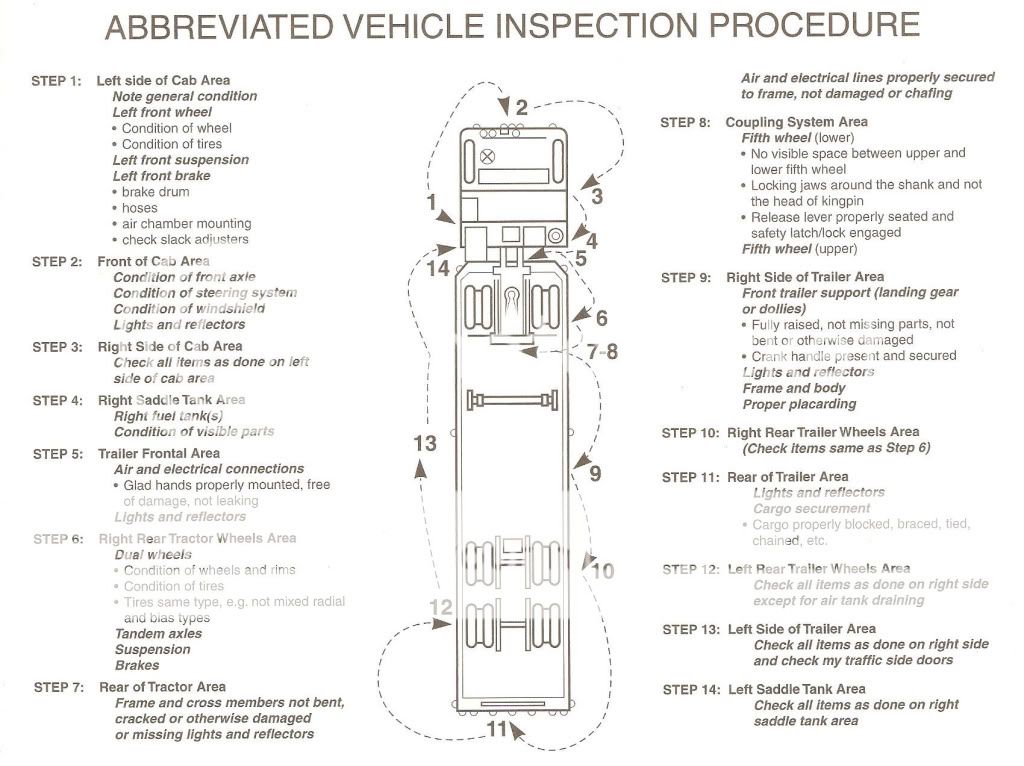
The "Pre-trip" is a systematic inspection of the tractor and trailer that one must perform each and every day.

There are something close to 200 inspection points on each rig that need to be looked over every single morning, no matter how crummy you're feeling or if it is raining cats and dogs outside. In truck school, the Pre-trip is one of the things that you learn by rote and have to practice every day. You need this knowledge for the DMV test, as well as for on the job. Before one can qualify for a commercial driver's license, the Pre-trip sequence is something that one must recite from memory in front of the DMV Examiner perfectly. If the hapless applicant cannot recite, define and point to 200 separate truck thingies straight from memory, they cannot proceed to the rest of the test, no matter how well they know to drive a truck.

The DMV is strict on the Pre-trip part of the exam for a very good reason.

"Essentially," the teachers said, "you are piloting an 80,000 pound bomb!" My teachers repeated this phrase over and over. It is a good meme, so I will feign originality and just repeat it here.

So every morning, I get out and check out a bunch of stuff, open the big 'ol hood and look for things that seem out of place, check fluids, check hoses, check belts, look for seepage, leaks and drips, make certain that all the lights work, that sort of thing. This inspection should take about 15 minutes when done correctly; the Company is keeping track of the time that it actually takes. Before doing the inspection, I tell the Qualcomm that I am "on duty" but not yet in "driving" mode. (The Qualcomm always records when you're driving) The Company has immediate access to live data and the Qualcomm machine is telling them in real time just exactly what I am up to. And believe me, they look. Woe to the driver who just starts driving without doing a proper inspection beforehand! No cheating! (The Pre-trip actually takes me only eight minutes, I pick my nose for the remaining minutes)

I am not only doing the Pre-trip just to please my corporate overlords; it is my very own fanny that I am trying to protect. If something has broken loose during the previous days' trip, I kinda want to know about it before I am out there on the road, driving 55 miles an hour and piloting an 80,000 pound bomb down a mountain, for goodness sakes.

I have the same Peterbilt tractor every day, but the trailer is always different. Most days, I usually start out with one trailer and end up with a different trailer. Whenever I hook up to a new (unfamiliar) trailer, I thoroughly check it out: I make sure that it has a solid frame, that all its lights work, that it has current registration and I also make sure to check the air pressure in the tires.

That would be eight tires to check, by the way, AKA "Duals". Usually, anyway. Some of the newer trailers have "Super Singles", which are big, wide, modern tires. Then, you will only have four to check with the tire air pressure gauge.There is no real shortcut, checking the tire pressure one by one is the only way to know that you're safe to roll and that you won't crash your 80,000 pound bomb into a hapless Prius. By the way: checking the trailer tire air pressure is, to put it plainly, a bothersome pain the ass.

So then, you are halfway to your destination and you pull over alongside the road for the night. The next morning, you still have to check out your tractor and look for leaks, drips and seepage, check out your lights and stuff, but you don't have to check the air pressure on the trailer tires with a tire pressure air gauge this time. What you do instead is to use a hammer, walk around the rig and "thump" it on all the tires to ensure that they're holding air and, supposedly, you're good to go.

Now then, while this is the way that I was taught, not everybody agrees with this method. The correct way, the naysayers maintain, is to use an air pressure gauge. Thumping on tires is never a substitute for accuracy, as some clearly paraphrased sources might say.

I had parked for the night in Parma, Idaho, and was doing my Pre-trip the next morning. I walked around the trailer, looking for signs of things out of place, looking underneath the trailer to make certain that none of the previous evening's libation enthusiasts were asleep underneath and I was thumping my hammer on each tire as I went.

I heard "bong, bong, bong, bong...thud".

"Thud" is not the sound that I wanted. I scurried back to the tractor and grabbed my air gauge.  The offending tire only had 25 pounds of air pressure in it when it was supposed to have had 90.

I was suddenly a believer in the "thumping" method. I immediately sent a Qualcomm message to the "On The Road Support" department, and they sent out a nice man who put a new tire on the trailer while I sat and watched.

The really good news is that I had done everything right: I had done my Pre-trip, I had discovered a flat tire before I had departed, not while I was going down a long, steep curve with a 6% grade with a full load in an 80,000 pound bomb. Live another day.


Tuesday, June 11, 2013

Truculent

After spending nearly a month in training, I was owed some time off. I got a ride down to our Company's yard in Yolo County; I hitched a ride with another May driver who was headed that way anyway. Our yard in Yolo was also where my new truck happened to be parked.

I had been given an ignition key and a form to fill out, sort of like when you rent a car from Hertz; look for pre-existing dings and dents so that you won't get blamed for them later.

Newbies usually get the oldest, grottiest equipment. I didn't know much about the truck; its year and mileage were not listed anywhere. I had no idea of its condition, age or worthiness. I only knew that it was a Peterbilt and it was going to be mine to drive. Having heard tales from other drivers picking up their trucks, I had expected the worst.

I found my truck in a dirt parking lot filled with other identical trucks. I climbed inside and saw that it was relatively clean and the mileage was quite low: just under 200,000. I had expected closer to 450,000.

My new truck, as it turned out, was just fine.

My first "load" was up to Chico. I was supposed to pick up a heavy load of flavored fizzy water and bring it back up to the main yard in Brooks, OR. I had been to this particular shipper before. Everything went well as I backed up to the dock, got my load and was back on the road. As this was a "heavy load" (over 40,000 pounds) I needed to get it "scaled" (weighed) first. I drove to the scales in Corning and got the truck weighed, paid with my Comdata card (that bizarre debit card system that Truckers use) and was on my way.

A little while later, I received a message on the Qualcomm box instructing me to get 50 gallons of fuel at the Pilot station in Weed. I had only a vague idea of how to go about doing this (the mechanics of paying for fuel with only a Comdata card at that time were still a mystery to me), but I got through it with no mishaps. Apparently, purchasing fuel there is considered too expensive, so the the company gave me enough to get by but wanted me to wait until I was back "home" to do a proper fill-up.

Next on my agenda was getting my butt back on the freeway and heading north. After Redding, I encountered hills.

My new truck and I were not the best of friends yet. I kept annoying it by asking it to go into gears that it would rather have no part of. It wasn't all that sure how it felt about me, its new driver. It quickly let me know when I  had annoyed it, and I was doing that often.(I had been trained on a Freightliner, but this was a Peterbilt. Similar, but different enough to be a pain. All of our trucks, regardless of brand, have the same 13 speed transmission, but what had been smooth shifting on the Freightliner was now not.)

The hills on the Siskiyous are really not all that steep. The highest pass is only at 4,000 feet or something like that. But when you have a heavy load of flavored fizzy water and you're going up a hill, downshifting quickly quickly and smoothly becomes quite important, and I wasn't doing either well at all. Unfamiliar truck, buttons and switches in all sorts of different places, steep hills, heavy load and a full bladder. I was a wee bit stressed.

But I made it over the hill and back up to Salem where the Mothership is located. Once there, I "dropped" the trailer (another driver would be taking it the rest of the way; final destination Puyallup).

While I was at our home yard in Brooks, Oregon, they sent me a message to pick up a trailer full of C&H sugar and haul it up to a couple of Costco store locations in Washington.

I was all set to go, but the trailer full of sugar was not at the yard waiting for me; it was still en-route. Damn.

It would be en-route for several more hours, which meant that I would not be able to get going that day, for I was just about out of available driving hours. The delivery had to be made at 5:30 the next morning, which meant that I would need to be on the road by 2:30 am at the latest. (insert grumbling here) I woke up early enough and, amazingly, the first stop went fine. The second stop was the problem.

The second Costco store had a loading dock that must have looked pretty good on paper, but was just way too difficult for me to back into. Here I was, trying to get my set-up right, yet there was a concrete planter box right on front of my truck. Then, to make matter worse, employees had parked their cars exactly where I needed to pull forward. I just couldn't do it. I tried over and over and was getting more and more stressed and performing worse and worse each time. Finally, another driver showed mercy on me and backed the truck up to the dock for me. I would still be there if he hadn't, still trying to get my set-up right. It was very humiliating.

When I was done with Costco, the Qualcomm sent me over to Olympia, WA to do a "drop and hook". I "dropped: my trailer (no more Costco sugar) and "hooked" up to a new one filled with paper. This new load needed to go someplace near Astoria.

"Drop and hook" is the easiest thing that one can do. It is much better than a "live load" because you don't have to wait for humans to unload the truck and so, theoretically, one can get back on the road quicker. It still takes some doing, though. One must visit the Shipping office and get instructions and paperwork. Each office has a different set of procedures and each office just assumes that every other office operates like they do and you must be a friggin' idiot for not instinctively knowing theirs.

So you get the papers, slide your tandems all the way back, break the seal, open your trailer's doors and try to back up to the right door without hitting anything. You set your brakes, turn off the engine, climb down, grab your gloves, chock the wheels, pull the kingpin release handle, lower the landing gear (always a puzzle for me, as they vary and can be quite balky), undo the air line glad hands and electrical "pigtail", stow them safely, lower the airbags and drive away.

Then, you find your empty trailer (the right one, not just any old one), back up to it, set your air brakes, climb down backwards out of the truck, check the fifth wheel clearance, climb back into the truck,  release your air brakes, back up until you hear the locking jaws engage, do a "tug test", set the air brakes, shut off the truck, climb down backwards out of the truck, raise the landing gear (which way is "up" to crank? I can never remember), hook up the air line glad hands, hook up the electrical pigtail, climb back into the truck (forwards), turn on the headlights and the four-way flashers, wrap the seat belt around the trolly brake, climb down out of the truck (backwards!), grab the air gauge from the door pocket, inspect the trailer for gouges, check the air pressure on the trailer's tires, check that the trailer's lights are all functional, check the registration and DOT inspection sticker and note which month when the trailer was last inspected, check the license plate light and door latches, slide the tandems (forward this time), climb back into the truck forwards and take a sip of water.

Before you go anywhere, you must send in a message saying that you're now empty so now they can load more work onto you.

In this case, I had dropped an empty trailer and was picking up a full trailer and taking it to a place near Astoria. Getting down there was fine, but it takes time to get off of I-5, snake through the town of Longview and drive up and over the Lewis & Clark bridge to Hwy 30. I made it on time, dropped my load and everything was OK.

Three loads in one day wasn't enough. They added a new load onto me, and by this time it was afternoon. I sent a message to my Driver Manager stating that I probably would not be able to complete this load on time. She tells me to "roll" anyway. I had started driving shortly after 2:00 am and I was losing it; exhaustion was setting in and I was moving in slow motion. I was in a Georgia-Pacific facility, and, in addition to all the trailer-dropping procedures listed above, I had to contend with 15 mph speed limits, speed bumps and the GP employee time schedule which, frankly, isn't quite as time-sensitive as my own. The GP employees don't have 14 hour D.O.T. clocks, but I do. Now I have a loaded trailer, so I have to send a "loaded call" on my Qualcomm, one that takes time (it asks you for all sorts of information; fluid levels, trailer sticker number, temperatures, etc.) and a separate "departing shipper" message. And I still had to snake through the facility, over the speed bumps, stop, sign forms with the guards and have them check my seal number to show that it was intact. My Driver Manager "sees" that I am not moving, decides that I am just screwing around and sends me a snippy message.

I make it as far as Longview, WA, pass a likely truck stop, take the next street in hopes of making a U-turn and returning to that truck stop to park when my Qualcomm machine sounds a loud "gong" warning me that I had only 20 minutes left before I was in violation. So I just stopped. I didn't even return to the truck stop. I found a wide spot to pull off the road right there and stopped right there for the night. I was exhausted, I was sweaty, I was in trouble with my Driver Manager and I hadn't even finished my first week yet.

At least I am still in D.O.T. compliance. This load will just have to wait until the morning.

I am going to sleep now. Screw it. 


Saturday, May 18, 2013

The Training Bro

I am still in training. I am also exhausted from long hours and irregular sleep.

Training seems like it will never end. I started nearly three weeks ago and I still have about a week left to go before the company considers me to be sufficiently trained. I figure that, at this point, I am about 93% ready to be pushed out of the nest.
"Best coffee on the Interstate"

I am slowly getting the hang of it. I have finally learned to downshift, I no longer stall the fully-loaded truck while going up steep grades, I have finally learned how to slide my tandems forward and backwards without injuring myself, I have a better idea of adjusting loads (so the truck won’t be overweight at highway scales) and I am getting used to the idea of infrequent opportunities with which to bathe. And even though I am often stinky, I have my very own "truckers" coffee mug.

However, I am still wrestling with the Qualcomm unit.

Inside each truck lives a device that looks sort of like an institutional, ruggedly-built, beige plastic laptop computer. This what we call "the Qualcomm"; it monitors everything. The machine makes a sound like a hawk in distress whenever a new message comes in. Through it, we keep in constant contact with the Driver Manager and receive daily "helpful" missives from the Safety Department (messages that usually border on the bloody-obvious).

This balky device is our main tool for conveying information back and forth to and from the company. They use it to tell us where we are to go, precisely which routes to take, where to get an emergency repair done and where we should go to fill up with fuel. In return, we use it to let them know when we have arrived at a shipper, when we have departed a shipper with a fully loaded truck or when we have broken down on the side of the road and the entire truck is now on fire. The possibilities are endless.

The Qualcomm device is also used to maintain the all-important D.O.T. log.

The days of paper logs, the system where a driver uses a ballpoint pen to write in a book (and, just maybe, keep a second copy showing fewer driving hours) are just about over. Most companies already use electronic "logbooks" and the company that I work for is on-board and up to date. By 2014 or so, electronic logs will be mandatory in all big trucks nationwide anyway. This forthcoming mandate has seriously impacted any thoughts that I ever might have had about popping a handful of little, white pills and running a illicit load of Coors through the south.

Which brings me to Hours of Service.

For a moron like myself, one who never did really well at basic arithmetic during elementary school, correctly understanding my own H.O.S. is mind-numbingly confusing and difficult. The gist of it is that I have 14 hours (total) a day to work with, and, out of those 14, I can legally drive 11 hours.

But, if I am inefficient with my time, I can also fritter away hours from my 14 which subtracts valuable driving time from my 11 and that makes me very sad. I can allegedly work up to 70 hours in a week, but I must be in the sleeper berth for a goodly portion of that time though I must be off duty for another period (but not during the same period), though that doesn’t stop me from simultaneously working on other vital stuff, but not driving, whereupon I must take a 34-hour “reset”, which makes perfect sense, unless I am working on an 8-2 split or if I am doing a required recap, (AKA rolling your hours) at which point I curl up into the fetal position and sob quietly on the floor right next to the steering wheel.

Thankfully, the Qualcomm keeps track of available hours for me.

My life now largely consists of getting up before dawn, climbing down out of the upper bunk, putting on my shoes, climbing down backwards out of the truck and scampering to the restroom before I wet myself. After that, I return to the truck, change my H.O.S. status on the Qualcomm thingie from "sleeper" to "off duty", then go about finding some substandard coffee for my new coffee mug. One I am sufficiently caffeinated, I change my status to "on duty", do the morning pretrip inspection, climb back in, change the Qualcomm to "driving" and then try to drive somewhere without running into anything along the way.

Meanwhile, my trainer prompts me to remember all the things that I have neglected to remember. Some day, I actually will get it. I am not all that worried though, because if these guys can learn it, then so will I.

And at the very least, I have a new coffee mug.


We swap trailers just about every day, and occasionally we get one that has had an awkward repair.


Monday, May 06, 2013

All trucks are grey in the dark

At 4:00 am it was still pretty dark outside.

I parked my car, grabbed my duffel bag and went looking for my trainer's truck. All trucks are grey in the dark. I was in the right place, but I couldn't find my trainer and I couldn't find his truck. 

The right place was a dirt lot that filled with identical trucks. I finally located my trainer, climbed aboard his truck and stowed my duffel. This would be my home for the next three weeks. I would sleep in the cramped, top bunk. Bathing, decent coffee and speaking with anybody who shared my liberal politics would become a thing of the past.

It is now the end of that first week.

Once I had climbed up and into that Freightliner tractor, I would begin the real part of my education. Up until then, this whole truck driving thing had all been sort of theoretical. Now, that shit was real.

My company-supplied trainer has trained many before me; he is knowledgeable, patient and is quite the chatterbox. For the first two days, I rode in the passenger seat, listened and soaked up gobs of information, (most of it too boringly truck-specific to bother you with) but I would not be allowed to drive the truck.

When it was still quite dark out, we drove out of that dirt lot in Woodland down I-5, over to I-80 and eventually made it to Milpitas with a load; somebody else's load that was embarrassingly late. The load was so late that the consignee refused us, so we dropped off the entire trailer, still sealed, at one of our company's yards nearby in Lathrop and swapped it for an empty. Then, we drove somewhere else and picked up a load of ketchup and took that replacement trailer all the way up to Everett,WA.

After that, we went here, there and everywhere, picking up and dropping off all sorts of things; new pallets, giant paper rolls, hardware and garden supplies, boxes of paper towels. Nothing really all that special. Just stuff. Anything and everything. Drop off a trailer with stuff, swap it for an empty one. The destinations soon ran together. There were no wasted minutes, there was no time to relax. Sometimes we had to wait for people with forklifts to unload us, but mostly we just swapped full trailers for empty ones and were on our way. I didn't just sit, I helped to do stuff: raising and lowering landing gear, doing pre-trip and post-trip inspections, thumping on tires with a mallet, hooking up and detaching the air supplies and its "pigtail" electrical hookup. But no actual driving.

After a couple of days, my head was about filled with stuff.  (I keep learning gobs of stuff and the memorization never seems to end. I am naturally curious and I like to learn stuff, but come on! Enough already!)

On the third day, my trainer suddenly announced that I would be driving from then on. He would sit over in the passenger seat. I would drive.

Although I had driven a similar, newish Freightliner truck for a few short minutes during my orientation, I had never really driven one, never taken one beyond eighth gear. This new truck sported a 13-speed transmission, and now I needed to learn how to use its "half-gears", whatever the hell those were.

Also, I had never driven a loaded truck; in school I had only pulled empty trailers. That was about to change.

For that matter, I had never driven a loaded truck up and down a real hill of any importance. That changed too.

Lessons on everything continued, plenty of mistakes were made. I made slight improvements. Very, very slight improvements. I also made plenty of mistakes: I missed gears, I grinded gears, I took forever to back up to loading docks, I asked lotsa really dumb questions. But I continued to improve. After awhile, I made fewer stupid errors, though I still have a long way to go. And I will invent new mistakes to make.

As I write this, I am sitting in Gilroy, California, having driven down from Kalama, Washington, around Oregon and Washington for awhile and down I-5, past Ashland, up steep grades over the Siskiyous and down the other side, down through the Sacramento Valley to the Bay Area, down past San Jose to Gilroy, where I finally had a chance to write some of this stuff down, and where I finally got a chance to pee.


Friday, April 26, 2013

If you carrot all, you'll eat healthy.

The next two days of orientation at the trucking company were fairly similar.

There was the same bulbous instructor guiding us through various segments of the things that we needed to know. There was a parade of  representatives from various departments (Employee Benefits, Safety, Compliance, etc.) telling us what they did, what their concerns were and what they really wanted us to do now that we knew what their concerns were. They showed us how their GPS-enabled software knows exactly where you are at all times, how fast you're going, what gear you're in and how much fuel you're using. Kinda scary, actually.

During our breaks, I drank 35¢ diet Cokes and eavesdropped on sophomoric discussions of which caliber of handgun provides the most stopping power and how much some of my group despised the current President. Sadly, no discussions about Public Radio or this week's edition of the New Yorker.

To liven things up, our group was shown several videos illustrating how we would get into trouble, lose our jobs and kill scores of innocent school children if we did certain things that we all are now pretty convinced that we should never do. One of the better videos focused on driver health, or, more specifically, the lack thereof. Regular exercise (going on refreshing walks around truck stop parking lots is in my future), stretching exercises (up against the side of a Peterbilt) as well as the dangers of relying upon a diet based solely upon fast food.

In that video, a rich actor (playing the part of a underpaid truck driver) reached into the cab's cubbyhole for a Red Delicious apple whilst driving. Meanwhile, the voice-over actor recommended eating lean meats, whole grains and keeping a steady supply of fresh apples readily available for snacking upon, as well as some baby carrots. The class was quite amused the notion of eating baby carrots. I think that they were amused by the whole concept of vegetables, an unfamiliar food group.

After briefly touching upon the healthy trucker lifestyle concept, we were whisked away to the "mixed-message lunch". Lunch that day was held at the Hometown Buffet, a destination sadly overlooked in the "healthy lifestyle" video that we had just watched. Once there, everyone piled their plates high with hot food items that are illegal pretty much everywhere except in the southern United States. I avoided the chicken-fried steak with fetid Country Gravy and sat away from the others, all by myself, so that I would not have to discuss the merits of magnum over regular ammunition. On our last day, we went to an execrable Chinese restaurant that had pretty much the same menu as the Hometown Buffet, but with some Fortune Cookies for a bit of that Asian je ne sais quoi. There were no baby carrots.

We also got to tour through the company's office buildings, thereby disrupting folks who were just trying to get their work done. We got to interrupt the work of all sorts of nicely-dressed people sitting comfortably at their cubicles, staring at computer screens; the sort of of job I once had, back in another life. In addition to bothering the nice office people, we got to tour through where really big trucks get repaired after newbies like ourselves run into things.

The bulbous man issued us some supplies. We all received about a pallet's worth of manuals, rules and instructions, some trailer seals, a padlock and a mysterious steel tool that apparently is used for turning on lawn sprinklers. We also got issued a ComData card, some blank checks, a baseball cap with the company logo and a nifty lanyard sporting a nifty photo ID badge, the photo badge that signifies my employment.


Next week, I go out on the road with my trainer. I'm bringing apples.


Tuesday, April 23, 2013

What have I gotten myself into?

One day, I was somehow passing my DMV test and had become a licensed driver. The next day, May Trucking called and invited me up to "orientation", which I thought was just a fancy term for "interview".

The deal was that they would put me aboard a Greyhound bus and bring me up to their HQ outside of Salem, Oregon. Once there, they would put me up in a hotel, feed me for a few days and see if they liked the cut of my hijab. If they didn't, I figured that I would be shamed,  thrown back onto the Greyhound and, with my tail between my legs, forced to explain to everyone why I was such a loser (or looser, as so many people seemed to spell it nowadays). Instead of taking the bus, I opted to drive my own car up to Oregon; they promised to pay me back for my gas.

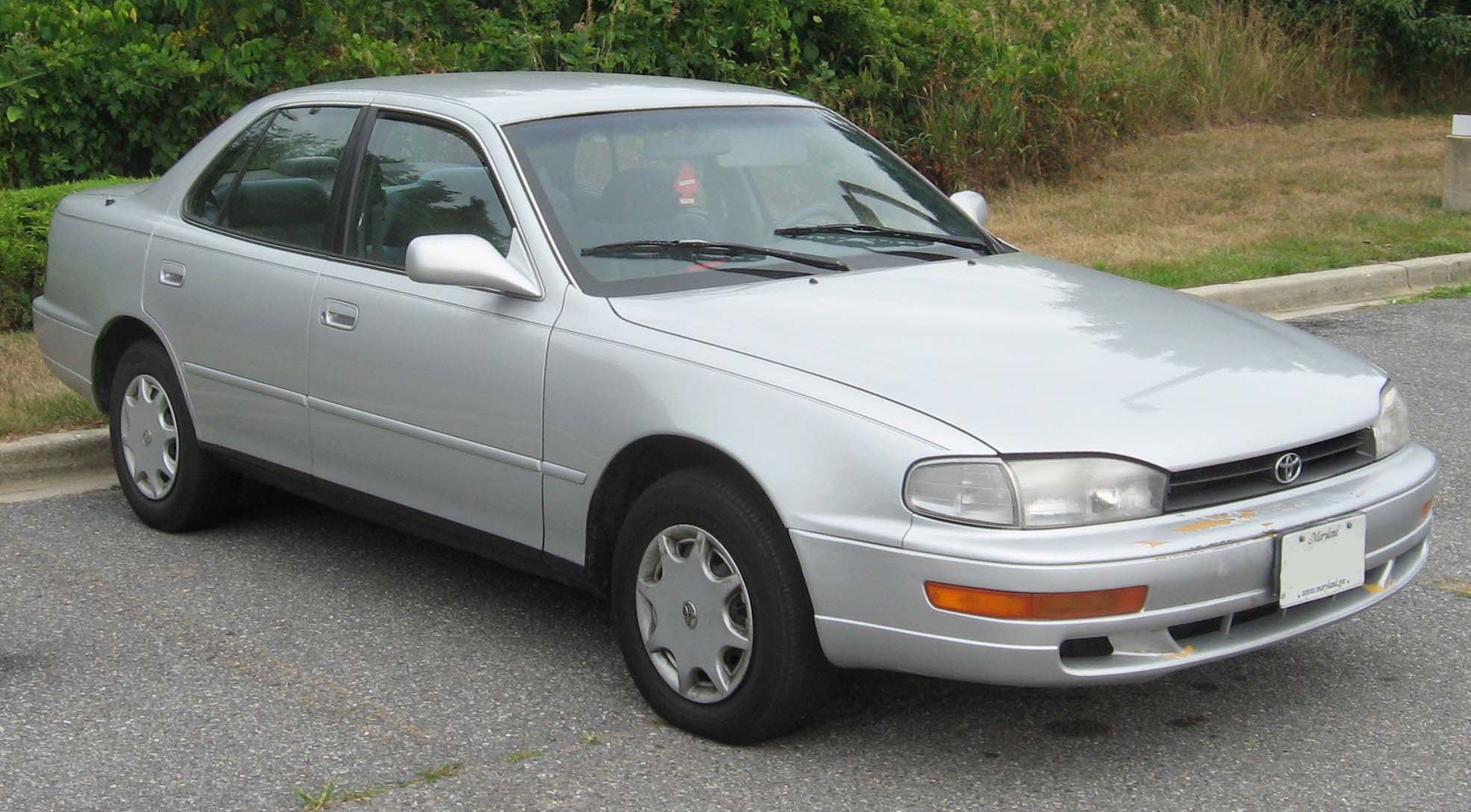
"It's a long way, about 500 miles", I whined to myself as I was driving up I-5.  I stopped whining when I realized that, from now on, I would be doing that every day. Fortunately, the driver's seats in Semi-trucks are designed for long trips, evidently the seats in my 1994 Camry are not.

I wondered what my classmates would be like once I got there. This could be really cool; it could be like when I was a college freshman: people that I met there would become my bestest friends, my BFFs, my friends for life! Or, (and far more likely) the people I met there would simply eschew me, look at me aghast, treat me like the misfit, loner and outcast that I always have been.

Being a Berkeley native and being brought up inside that strange fishbowl during that strange period long ago put me at odds with the rest of contemporary society. Even nowadays (with our polarized country), I feel as though I really don't fit in anywhere. This new career may be my best chance for me just to stay outside. I tossed and turned all night, worrying myself into a tizzy about the possibility of failing, especially of failing the skills test.

The next morning, I helped myself to the motel's free continental breakfast. I ate a healthy breakfast: raisin bran with skim milk, a piece of fruit and a hard-boiled egg. At about 7:30 am, a company van came to the motel to pick up all the people going to orientation. There was a crowd of people already outside, all waiting for the van. But they were not my people at all: dressed up in stereotypical trucker garb, ball caps, Carhartt jackets and all wearing Bluetooth earpieces, these were "Super Truckers". Certainly, these were not my fellow "ERD's" or "Entry Level Drivers"; they must all be experienced drivers who were attending orientation just in order to learn the company culture before they go back out on the road.

Where were my people? The newbies, still wet behind the ears from trade school? The ones with pierced ears, sporting expensive, bright red hi-top sneakers listening to that hippity-hop music with over-sized earphones? None of those people were around. Maybe they overslept?

I drove myself the six miles to school, parked in the lot and asked to be directed to "Orientation". Once inside, I found myself  right back with the same guys straight out of Central Casting, the ones who seemed to be auditioning for a part in the next installment of the Smoky & the Bandit series. I took a seat and simply waited to be curtly redirected to the correct classroom. Although it was still before 8:00 am, everybody in the room already had a folder of important papers except for me. I started fiddling with my smart phone, still waiting to be told that I was in the wrong location.

A man came in and told me to follow him out to the parking lot.

"Are you sure?" I asked. "I haven't shown my paperwork to anyone yet", I told him. He replied that I was indeed in the right place, that the paperwork could wait and that we were going out for a road test. I told him about all of the "real truckers" that were in the room and he told me that out of the 10 people there, only one was an experienced driver; the rest were newly-minted graduate newbies like myself. And as for the extreme trucker garb, well, they apparently wanted to make a good first impression. With my fleece jacket, designer glasses and Merrell boots, I looked like I was there to attend an Audubon Society luncheon.

We walked out through a gravel parking lot, it was filled with enormous semi-trucks and trailers. These were not the ratty old school trucks that I had trained on, these were the real thing: shiny trucks built fairly recently, fancy models that had actual working lights and gauges. 


We did a light 'once over', not really a proper pre-trip inspection, just to make sure that the fifth wheel release bar was secure, we both climbed inside and I was instructed to drive back through the lot, out the gate and onto I-5. The tractor had a 13 speed transmission, one that I had never seen before. It shifted like a dream, assuming your dreams include double-clutching. I drove the prescribed loop, took my turns correctly, check my mirrors often, downshifted well enough and returned to the yard without embarrassing myself too badly. I had passed the road test.
 
Next, I was again snatched out of orientation by a different fella and driven to the back of the lot where there was an obstacle course set up with old truck tires and other nuisances. 

This was the "skills test" part of the orientation. I knew only a couple of things about it: that it was extremely difficult and that failing it would send me home that day. The skills that one had to show seem fairly easy as described: just do a prescribed right turn starting from a fairly shitty beginning (trailer positioning already tweaked so that it would be hard to recover), a straight-line backing (easy-peasy) and then a 45 degree alley dock. All stuff that I had trained on.

Of course, I had not trained on doing them with a 53 foot trailer or with my career at stake. 

The good part is that here, "pull-ups" were not penalized. (The DMV docks you a point each time you do a pull-up). Oh, and there was this little matter of a horse-shoe shaped portion that one needed to negotiate without hitting anything. Would have been a cinch, had I been driving a Smart Car, but I was not. Instead, I was driving a vehicle that was approximately the size of New Hampshire. Again, I took it slowly and somehow I passed the skills test. 

Back to the classroom and do some more paperwork, then went somewhere to correctly pee into a special cup. I passed again. At about noon, someone delivered about a million bad pizzas from Pizza Hut so we all ate pizza for lunch, thereby cancelling out my healthy breakfast.

After gorging on bad pizza, most of the others were sent off to get their DOT physicals done. That would take up the rest of the day. Since I had mine done just recently, I was excused to go back to the hotel. 

Once back at the hotel, I studied up for the nap test.